Choose a data flow
Start with customer updates, payments or sensor data.
Replace point-to-point links and ageing middleware with real-time data flows that every team can use, one system at a time. Governed, on open Apache Kafka, and running where your data must stay.








Integration modernisation means replacing point-to-point connections, batch file transfers and ESBs with an event-driven architecture, where systems publish changes as they happen and authorised teams can use them. Most organisations do this gradually: new applications connect through an event streaming platform while existing integrations keep running. Axual supports this with a governed platform on open-source Apache Kafka, in your own data centre, your cloud account or on Scaleway, a European cloud.
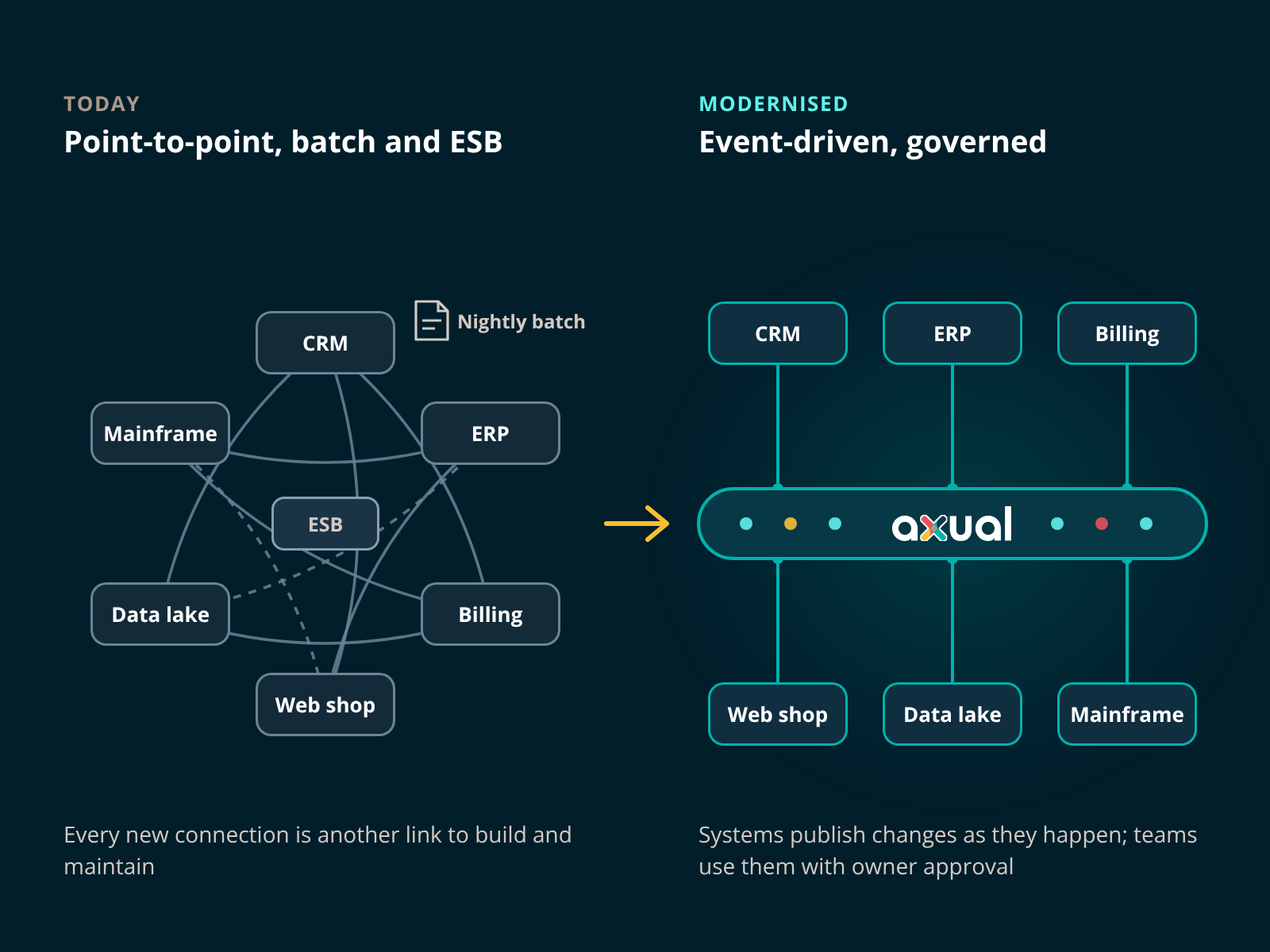
Changing one core system can mean retesting dozens of interfaces. Nightly batch jobs delay data, and central middleware adds licence costs and makes every change depend on one specialist team.
The business needs real-time services, current data for AI and the ability to replace systems without rebuilding integrations.
Systems publish events such as payments and meter readings to a shared data layer. Teams with access can subscribe in real time without a new interface for each team.
Data moves the moment something changes, not in tonight's batch.
Teams connect what they need within guardrails set by the platform team.
Replace or upgrade a system without breaking everything connected to it.
Every data flow has an owner, and every access is approved and recorded.
Run Axual alongside your existing middleware and migrate one data flow at a time.
Start with customer updates, payments or sensor data.
Use Kafka Connect to stream data from an existing database, message queue or application to a Kafka topic.
Teams request topic access in Axual Self-Service, then subscribe once approved.
Switch it off once all consuming applications have moved to Kafka.
Most teams see the first flow in production within weeks, not years.
Axual is the governed data layer at the centre of this architecture. It's built on open-source Apache Kafka, the standard for event streaming, and adds what large organisations need to let many teams use it safely.
Built on open Kafka, so the new integration layer doesn't become the next lock-in. If you ever leave, you keep standard Kafka.
It's the move from point-to-point connections, batch transfers and central middleware to an architecture where systems share data in real time through events. The goal is integration that's faster to change, easier to govern and ready for real-time services and AI.
No. Most organisations run the event streaming platform alongside existing middleware and move integrations over one at a time, starting with the flows that are slowest or most fragile today. Old interfaces are retired once nothing depends on them.
An ESB routes and transforms messages centrally, usually managed by one integration team. Event streaming lets systems publish events to a shared, durable log that many teams can read independently, in real time and at high volume. Logic moves closer to the teams that own the data, while governance stays central.
Yes. Connectors read changes from databases, message queues and applications and publish them as events, so existing systems take part without code changes.
With Axual, every data flow has an owner and every access is approved and recorded. That gives you a clear picture of who receives which data, which supports the ICT risk management and supply chain requirements in DORA and NIS2.
Not with Axual. It's built on open-source Apache Kafka and Strimzi, so if you ever leave, you keep standard Kafka clusters and your applications keep running.